

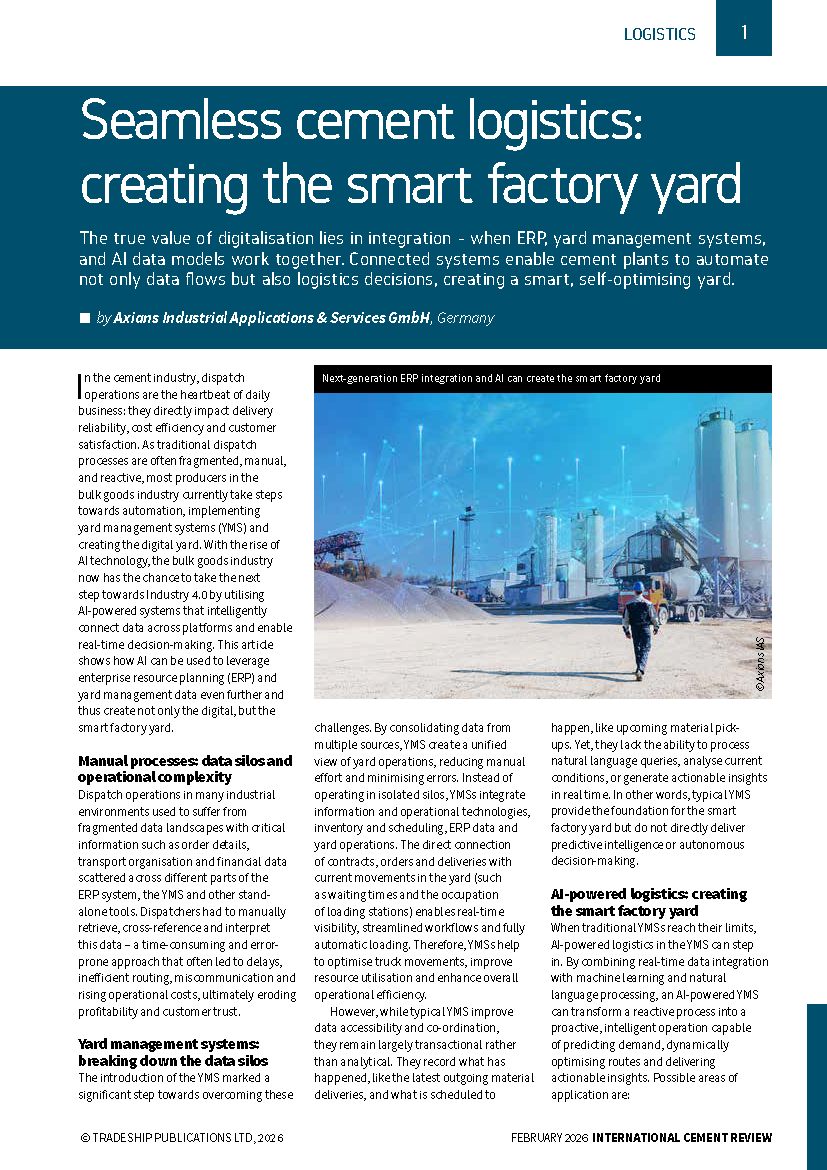
In the cement industry, dispatch operations are the heartbeat of daily business: They directly impact delivery reliability, cost efficiency, and customer satisfaction. As traditional dispatch processes are often fragmented, manual, and reactive, most producers in the bulk goods industry nowadays take steps towards automation, implementing Yard Management Systems and creating the digital yard. With the rise of AI-technology, the bulk goods industry now has the chance to take the next step towards Industry 4.0 by utilizing AI-powered systems that intelligently connect data across platforms and enable real-time decision-making. This article demonstrates how AI can be used to leverage ERP and Yard Management Data even further and thus create not only the digital, but the Smart Factory Yard.

Seamless Cement Logistics
How next generation ERP Integration and AI Create the Smart Factory Yard
Manual processes: Data Silos and Operational Complexity
Dispatch operations in many industrial environments used to suffer from fragmented data landscapes with critical information like order details, transport organisation and financial data scattered across different parts of the ERP system, the Yard management system and other standalone tools. Dispatchers had to manually retrieve, cross-reference, and interpret this data, a time-consuming and error-prone approach that often led to delays, inefficient routing, miscommunication and rising operational costs, ultimately eroding profitability and customer trust.
Yard Management Systems: Breaking down the data silos
The introduction of Yard Management Systems (YMS) marked a significant step towards overcoming these challenges. By consolidating data from multiple sources, Yard Management Systems create a unified view of yard operations, reducing manual effort and minimizing errors. Instead of operating in isolated silos, Yard Management Systems integrate IT and OT, inventory and scheduling, ERP data and yard operations. The direct connection of contracts, orders and deliveries with current movements in the yard like waiting times and the occupation of the loading stations enables real-time visibility, streamlined workflows and fully automatic loading. Yard Management systems thus help optimize truck movements, improve resource utilization, and enhance overall operational efficiency.
However, while typical Yard Management Systems improve data accessibility and coordination, they remain largely transactional rather than analytical. They record what has happened, like the latest outgoing material deliveries, and what is scheduled to happen, like upcoming material pick-ups. Yet, they lack the ability to process natural language queries, analyse current conditions, or generate actionable insights in real time. In other words, typical Yard Management Systems provide the foundation for the Smart Factory Yard but do not directly deliver predictive intelligence or autonomous decision-making

AI powered logistics: Creating the Smart Factory Yard
The introduction of Yard Management Systems (YMS) marked a significant step towards overcoming these challenges. By consolidating data from multiple sources, Yard Management Systems create a unified view of yard operations, reducing manual effort and minimizing errors. Instead of operating in isolated silos, Yard Management Systems integrate IT and OT, inventory and scheduling, ERP data and yard operations. The direct connection of contracts, orders and deliveries with current movements in the yard like waiting times and the occupation of the loading stations enables real-time visibility, streamlined workflows and fully automatic loading. Yard Management systems thus help optimize truck movements, improve resource utilization, and enhance overall operational efficiency.
However, while typical Yard Management Systems improve data accessibility and coordination, they remain largely transactional rather than analytical. They record what has happened, like the latest outgoing material deliveries, and what is scheduled to happen, like upcoming material pick-ups. Yet, they lack the ability to process natural language queries, analyse current conditions, or generate actionable insights in real time. In other words, typical Yard Management Systems provide the foundation for the Smart Factory Yard but do not directly deliver predictive intelligence or autonomous decision-making
Where traditional Yard Management Systems reach their limits, AI-powered logistics in YMS can step in. By combining real-time data integration with machine learning and natural language processing, an AI-powered yard management system can transform from a reactive process into a proactive, intelligent operation capable of predicting demand, dynamically optimizing routes, and delivering actionable insights. Possible areas of application are
- Intelligent dispatch scheduling
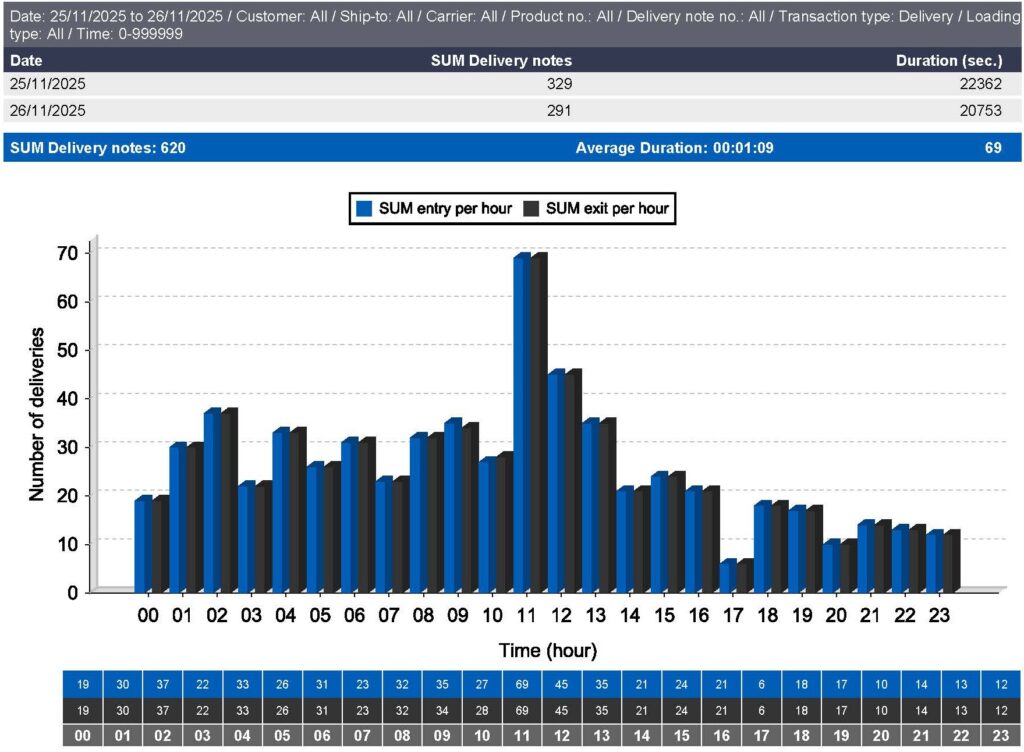
Keeping an eye on traffic volume in the yard: AI powered dispatch scheduling analyses orders, vehicle availability and real-time demand to automatically assign time-slots for material retrieval and dispatch, ensuring smooth operations and increased efficiency for both drivers and the yard.
- Predictive demand forecasting
The use of AI in demand forecasting transforms production planning from reactive to proactive: Through an AI-based analysis of historical data, patterns can be identified in the otherwise seemingly random fluctuations in material demand. This allows not only for precise production planning but also for load balancing, distributing the brunt of material demand at estimated peak times evenly across several production plants.
- Dynamic Order & Truck Assignment
AI-driven capabilities can enhance dynamic order–truck assignment, shifting the focus from static planning to continuously optimized logistics processes. Instead of relying solely on route optimization, the system will increasingly evaluate and match orders with the most suitable trucks in real time. By combining route data, delivery destinations, the truck’s position combined with additional live data from the yard, such an AI-supported assignment mechanism could not only adapt routes dynamically but also determine the most appropriate production site for material pickup. Together with intelligent dispatch scheduling and predictive demand forecasting, this creates the foundation for a self-optimizing feedback loop. - Comprehensive process analysis
A plethora of valuable data is collected throughout the yard every day, recording every event and incident – way too much for the human operator to review and understand. Comprehensive process analysis is a prime example for possible AI-use, as an artificial intelligence can consolidate and interpret large amounts of data, unveiling unexpected cause-effect relationships which deepens the understanding of processes and opens up potential for optimization. - Data queries in natural language
As the AI Agent sources data form multiple sources like the ERP system and the Yard Management, complex data queries in natural languages such as “list the Top 5 customers ranked by sales revenue for the last six months” and the subsequent creation of KPI dashboards become possible. On the customer side, AI opens up the possibility for asking for and receiving updates on the delivery status in natural language.
Use of AI in Yard Management Systems today
Even though the self-optimizing, autonomous Smart Factory Yard is still a long way off, more and more AI solutions can be used in Yard Management today, paving the way towards the Smart Factory Yard:
One of the most straightforward applications of AI in cement logistics is automatic vehicle identification. By using automatic number plate recognition (ANPR) at the plant entrance, cement plants can significantly speed up the check-in process.
Beyond vehicle identification, webcams and cameras provide other valuable applications in bulk goods logistics: At plant entrance and exit, AI can be used to identify the material on the truck or detect and check quality parameters. This facilitates the classification of material and waste, as well as pricing for incoming and recycling processes, and prevents incorrect deliveries for outgoing processes.
Furthermore, AI powered camera systems can monitor loading areas for cleanliness (e.g. detecting dirt at trucks and refusing to load) or assess the condition of rail wagons during loading. For bagged goods, AI can confirm whether proper load-securing measures have been followed and automatically document this through image analysis.
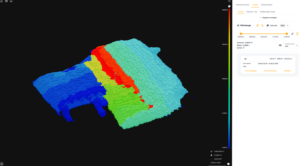
AI based camera and image processing solutions can also be used in plants with bulk storage (e.g. sand, gravel, or calcium carbonate) to measure and monitor material volume in stockpiles, enabling precise production planning and the assignment of loading areas in the yard based on current material stocks.
Transport optimization is another area where AI solutions are already being used today to improve logistics in cement plants: Historical data, planned deliveries from multiple sites, real-time traffic conditions and truck locations need to be considered in order to plan deliveries more efficiently. The AI uses simulations to compare different optimisation parameters like delivery punctuality, fleet size, or distance travelled. Seamlessly integrated with order taking and planning tools, the AI is able to implement real-time adjustments and optimise transport, reducing costs by up to 30% while improving customer satisfaction.
The next steps towards creating the Smart Factory Yard
For AI solutions to work effectively, a reliable and accurate database is required. Centralised solutions like the Axians VAS Yard Management, that integrate order and delivery data with ERP-data and real time data from the yard, build the basis for creating the Smart Factory Yard.
Axians IAS, the supplier of the VAS Yard Management System, has not only realized integrations with all of the above-mentioned AI solutions into its VAS system, but is also working on making further AI features available in the near future. For this, Axians IAS has partnered with Muhammad Bilal and his company Digital Data Enterprises, which specialises in ERP-system integrations and AI applications. As an insider in the cement industry and former VAS customer, user and administrator, Muhammed Bilal has a deep understanding of plant logistics processes has first-hand experience with the VAS Yard Management System.
The integration of AI with ERP-data and Yard Management will not only strengthen the integration and digitization of processes between sales and delivery, but also significantly simplify the operation of the systems for inexperienced users, bringing greater efficiency and transparency along the entire value chain.
This article was published in the
International Cement Review, Issue: February 2026